These are enlightened times for New York City's local streets. The city is building sidewalk extensions, protected bike lanes, and better busways. But at the state DOT -- the agency that controls the vast majority of New York's federal transportation funding -- much of the playbook still comes straight from the Robert Moses era. At a pair of public meetings yesterday, representatives from the state DOT's Region 11 office presented plans to jam more space for cars through the dense urban fabric of the southwest Bronx, just as the area appears poised to construct new housing, parks, and retail.
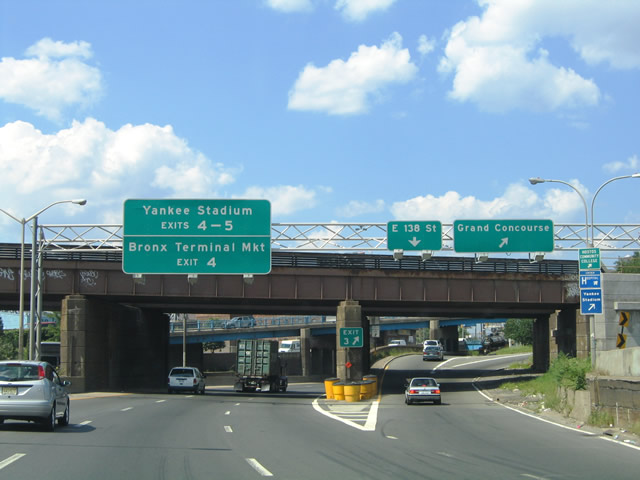
 The Major Deegan at the 138th Street exit. Does the South Bronx need a bigger barrier to the Harlem River waterfront? Image: AA Roads.
As the Daily News reported earlier this week, local residents fear the highway widening would also stifle redevelopment plans for this area of the Bronx and cut off waterfront access to the Harlem River. As part of the city's South Bronx Initiative, 1,500 units of new housing, 220,000 square feet of retail, and five acres of new parkland are slated for the immediate neighborhood around the state DOT project, said Walter Houston, head of the Local Development Corporation of the West Bronx. The bigger ramp would effectively block off pedestrian access to the redeveloped waterfront.
"It’s a wall between the community and the waterfront, which would only contribute to the deterioration of the waterfront," said Houston. "DOT is proposing a narrow tunnel through this wall, and that's it." A pedestrian tunnel under a highway exit ramp. Sound like an appealing way to walk to the new riverfront park?
The Deegan is an aging structure, and no one disputes that this segment needs a rehab. But according to the DOT, more lanes and wider ramps are needed to "address safety and operational issues" and alleviate traffic jams. "There’s a back-up on the Major Deegan throughout the day that ends up causing a lot of problems with congestion and air quality," said Levine.
Will building more space for cars solve any of these problems? "They’re adding an auxiliary lane and making the ramps two lanes," said Kyle Wiswall of the Tri-State Transportation Campaign, who attended yesterday's meeting. "You're now adding so much capacity for cars to get off the highway, in the long-term it’s going to attract more traffic. I don't see how that’s going to positively affect air quality, congestion, or safety."
DOT is also considering a rehab-only alternative, which would not add any new capacity. As of yesterday, said Wiswall, the agency could not provide a cost estimate for the rehab-only version. At a time when the state of New York is essentially
broke and the state DOT has no funding for its $25.8 billion, 5-year
capital plan, a simpler project with a smaller footprint should be a fiscal no-brainer.
If the state DOT wants to invest in this part of the Bronx, there are plenty of streets which could use some improvements. The Grand Concourse is one of the deadliest streets in the city: From 2006 to 2008, five pedestrians died in traffic collisions along the corridor.
It's not unheard of for the state DOT to funnel money toward pedestrian safety enhancements on local roads. Federal funding, for instance, helped build the Hudson River Greenway. But safety doesn't seem to be a high priority at the state level. As Tri-State analyst Michelle Ernst reminded us, the state DOT recently gave up 85 percent of its 2009 federal funding for ped-bike projects.
For Houston, the Deegan project exemplifies an agency stuck in the past. "This project was first conceived in the late 90s -- no one took into account the new way we look at transportation and mobility these days," he said. "Our redevelopment efforts are geared to the development of people, not the movement of cars."
Update: Elana Schor at Streetsblog Capitol Hill sends word from Congressman José Serrano's office. "I am distressed to hear that in a proposed redesign of exit and entrance ramps to the Major Deegan, the community could suffer a loss of access to their waterfront," Serrano said through a spokesperson. "Cutting access to these precious locations is unacceptable to me, to the community, and should be seen as a non-starter by the DOT."


.jpg)